
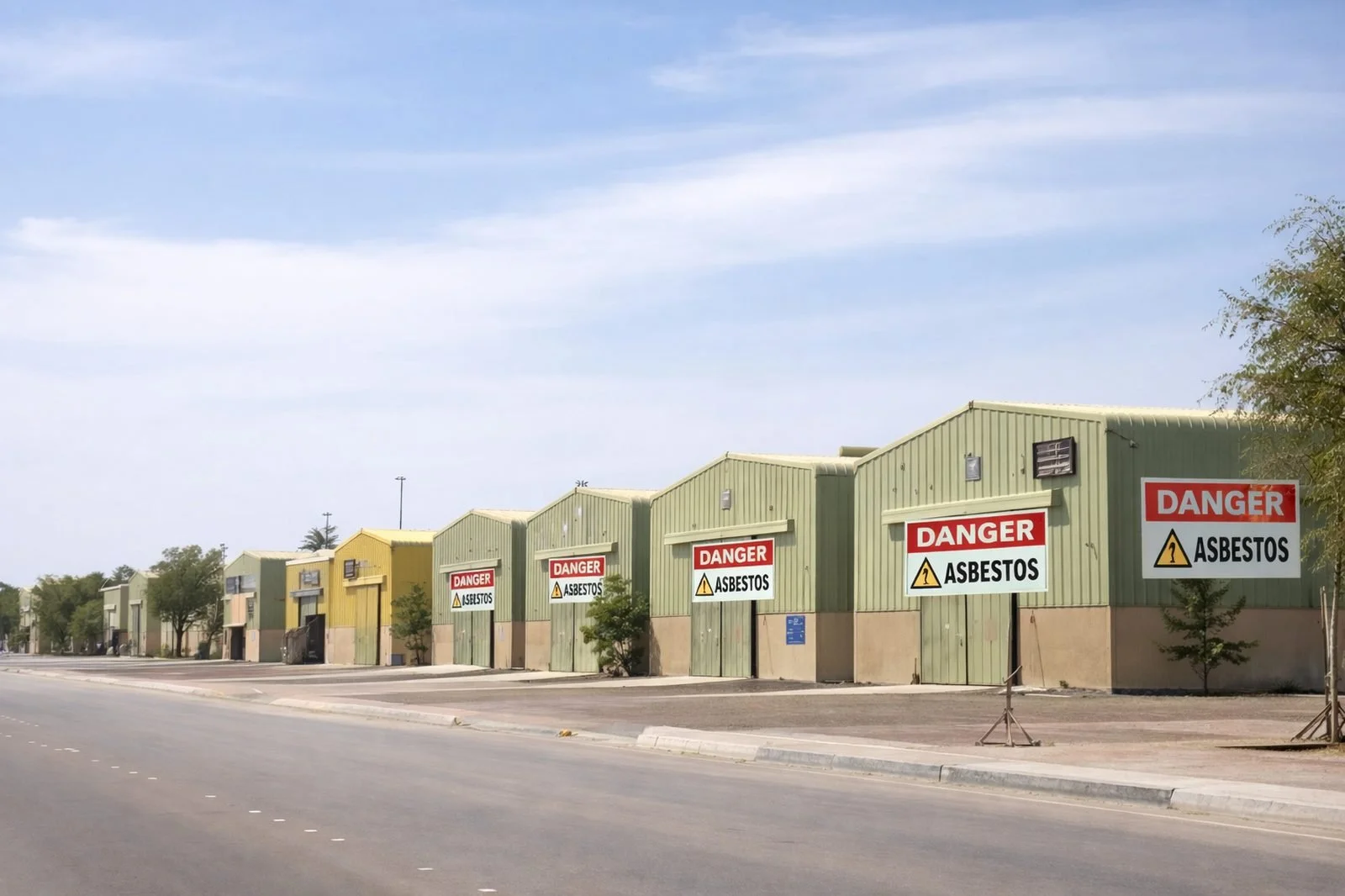
Industrial zones form the backbone of cities and Emirates across the UAE and the wider GCC. These areas support critical infrastructure—producing power, water, food, manufactured goods, and supporting logistics that fuel both local and international economies.
However, from an asbestos risk perspective, industrial areas represent some of the highest-risk environments in the built environment. The combination of heat-intensive processes, chemical use, ageing buildings, and frequent refurbishment or demolition creates a perfect storm for asbestos exposure if risks are not properly managed.
Why Asbestos Is Common in Industrial Buildings
Historically, asbestos was widely used in industrial facilities because of its:
Exceptional fire resistance
Strong thermal insulation properties
Chemical resistance
Durability under extreme operating conditions
For decades, asbestos-containing materials (ACMs) were deliberately incorporated into industrial building fabric to reduce fire risk from high-temperature processes and to protect structures from corrosive chemicals.
Unfortunately, while asbestos helped mitigate certain industrial hazards, it introduced a long-term occupational health risk. When ACMs deteriorate, are damaged, or disturbed, they can release airborne asbestos fibres. Inhalation of these fibres is known to cause mesothelioma, asbestos-related lung cancer, and asbestosis—often decades after exposure.
Common Asbestos-Containing Materials in Industrial Areas
Because of its versatility, asbestos was used in thousands of products. In industrial facilities, the most commonly encountered ACMs include:
Thermal insulation to boilers, pipework, ducts, and vessels
Sprayed asbestos coatings used for fireproofing structural steel
Asbestos insulating boards in walls, ceilings, fire breaks, and plant rooms
Gaskets and seals within pumps, valves, flanges, turbines, and compressors
Asbestos cement materials, including:
Roof sheeting
Wall cladding
Guttering and rainwater goods
Cable trays and arc shields
Asbestos within industrial equipment, including older machinery, furnaces, and electrical systems
Each of these materials presents varying degrees of risk depending on their condition, friability, accessibility, and likelihood of disturbance during operations or future works.
Older Industrial Areas vs New Developments
Asbestos is most commonly associated with older industrial buildings, particularly those constructed before national bans were introduced. In the UAE, this often includes warehouses, factories, and workshops in long-established industrial zones such as Al Quoz in Dubai and Mussafah Industrial Area.
However, it is important to recognise that asbestos risk is not confined to old buildings alone. There have been well-documented cases—both regionally and internationally—where asbestos has been identified in newer buildings, often due to:
Imported construction materials not subject to rigorous testing
Legacy stockpiles of asbestos-containing products
Poor enforcement of supply-chain controls
This reinforces the need for verification through professional asbestos surveys, rather than assumptions based on building age.
The First Step: Asbestos Surveys in Industrial Facilities
The cornerstone of asbestos risk management is identification.
A competent asbestos consultancy should be engaged to undertake an asbestos assessment, typically in the form of:
Management Asbestos Surveys – for occupied, operational facilities
Refurbishment/Demolition Asbestos Surveys – before intrusive works, upgrades, or demolition
These surveys involve:
A systematic inspection of buildings, plant, and equipment
Identification of suspect materials
Bulk sampling carried out safely and methodically
Laboratory analysis by accredited asbestos laboratories
The resulting asbestos survey report should include:
Clear descriptions of all identified ACMs
Annotated drawings and site photographs
Risk assessments using recognised criteria
Practical recommendations for management or removal
Managing Identified Asbestos: Removal or In-Situ Management?
When ACMs are identified, the legal and moral responsibility sits with the dutyholder to assess the risk and determine appropriate control measures.
Depending on the situation, this may involve:
Managing Asbestos In-Situ
Where ACMs are in good condition and unlikely to be disturbed:
Materials may be left in place
An Asbestos Management Plan (AMP) must be developed and implemented
Regular inspections and re-assessments are required
Clear labelling and communication with staff and contractors is essential
Asbestos Removal
Where ACMs are damaged, deteriorating, or will be disturbed:
Removal is usually the safest option
Works must be carried out by a specialist Asbestos Removal Contractor (ARC)
Removal should be supervised by a licensed Asbestos Supervising Consultant (ASC)
Air monitoring and clearance procedures should be implemented
Industrial Redevelopment: Lessons from Abu Dhabi and Dubai
Large-scale industrial redevelopment in the UAE highlights how asbestos can be safely managed when planned properly.
A notable example is the redevelopment of Mina Zayed, where hundreds of warehouses were surveyed for asbestos. Identified ACMs were removed in line with international best practice and local regulatory requirements, allowing redevelopment to proceed safely.
With increasing discussion around the redevelopment of areas such as Mussafah and Al Quoz, similar challenges will arise. Proactive asbestos identification and management will be essential to protect:
Workers involved in demolition and construction
Neighbouring communities
Future residents and commercial occupants
Why Proactive Asbestos Management Matters
Failure to manage asbestos risks in industrial areas can result in:
Serious long-term health impacts
Regulatory non-compliance
Project delays and cost overruns
Environmental contamination
Reputational damage for asset owners and developers
Conversely, early identification and professional management allow asbestos risks to be controlled safely, efficiently, and cost-effectively.
How We Can Help
With over a decade of experience delivering asbestos consultancy services across the UAE, GCC, Central Asia, and Africa, our team supports industrial clients with:
Asbestos surveys (management and refurbishment/demolition)
Asbestos Management Plans
Asbestos awareness training
Supervision of asbestos removal works
Independent air monitoring and clearance
If you have any Asbestos-related concerns or require asbestos-free certification for products or projects, contact Anthesis Consulting Middle East today.
Charles Faulkner (Head of Environment, Health and Safety, and Asbestos Team Leader)
Phone: +971 (0) 50 5541 320
Email: asbestos@anthesisgroup.com